
Writing in 8 bits.
I’m a huge fan of Shovel Knight. It captures everything that made classic platformers great and repackaged them for the modern era. The tight controls, the gorgeous pixel art, and the 8-Bit bangers are all parts of Shovel Knight’s sharp execution and proof of why old school side scrollers were best known for their gameplay. While it borrows much from these games, Shovel Knight doesn’t share their often poor or nonexistent storytelling. That’s not a dig on old school games, they were just more focused on learning how to be games than movies with quick time events. Their stories didn’t delve beyond simple objectives, and they didn’t really need to. With the modern age of gaming, there’s a greater emphasis on a game’s ability to construct a narrative. What I find interesting about Shovel Knight, is through its writing and gameplay it tells an interesting story, in a genre of games that’s not known for its storytelling or really requires it.
In many AAA action games or RPGs, a story is at least expected, regardless of quality. Players are more willing to sit through cutscenes and scripted conversations because they’re core parts of the experience. Classic platformers weren’t known for their stories, but Yacht Club didn’t bury their heads in the sand when it came to writing one. Sure, Man seeking McGuffin isn’t exactly groundbreaking when it comes to plot lines, but Shovel Knight’s storytelling works in a side-scroller because of how little it forces the player to passively sit through it. Much like the shovel, all of Shovel Knight’s writing is short and to the point, with the longest section of text used to establish the opening plot. The rest is troweled together through character dialogue that provides subtle insight into the game world. You’re free to keep playing, but if you’re interested in additional context to events, and wish your console doubled as a Kindle, then you have that option. People don’t come to platformers for their narrative appeal. The main draw is their short, punchy experiences, complemented by challenging mechanics. Shovel Knight manages to do both, containing an interesting story without sacrificing its gameplay.
While Shovel of Hope’s story is brief, its elements are well executed, especially it’s dialogue. Most of the optional dialogue comes from town NPCs that you can choose to interact with. This not only provides a way for developers to insert tips and reminders without creating an annoying companion character, but it also helps with world building. NPCs will talk about recent events, such as the undead taking over the Litch Yard, how it’s odd that Shovel Knight isn’t accompanied by Shield Knight, and then there’s this frog… that tells puns. The mandatory dialogue also services the story by building interesting characters. Before each major boss encounter, there is an exchange between Shovel Knight and a member of the villainous Order of No Quarter, The Enchantress’ elite group of knights. Where other games have their bosses grunt or perform an erotic mating display before they proceed to beat you over the head with… a shovel, Shovel Knight’s bosses provide a brief exchange before the paddle comes out. These interactions give each character a distinct personality. Some members of the Order take the dad approach by telling Shovel Knight he’s a failure. That he’s responsible for Shield Knight’s death, and it’s about time he moved out. These exchanges also imply that many members of the Order have their own personal agendas outside the main events of the game and work with The Enchantress out of convenience. This pause for dialogue not only gives the player some breathing room before a fight, it provides insight into characters that rarely get this level of attention.
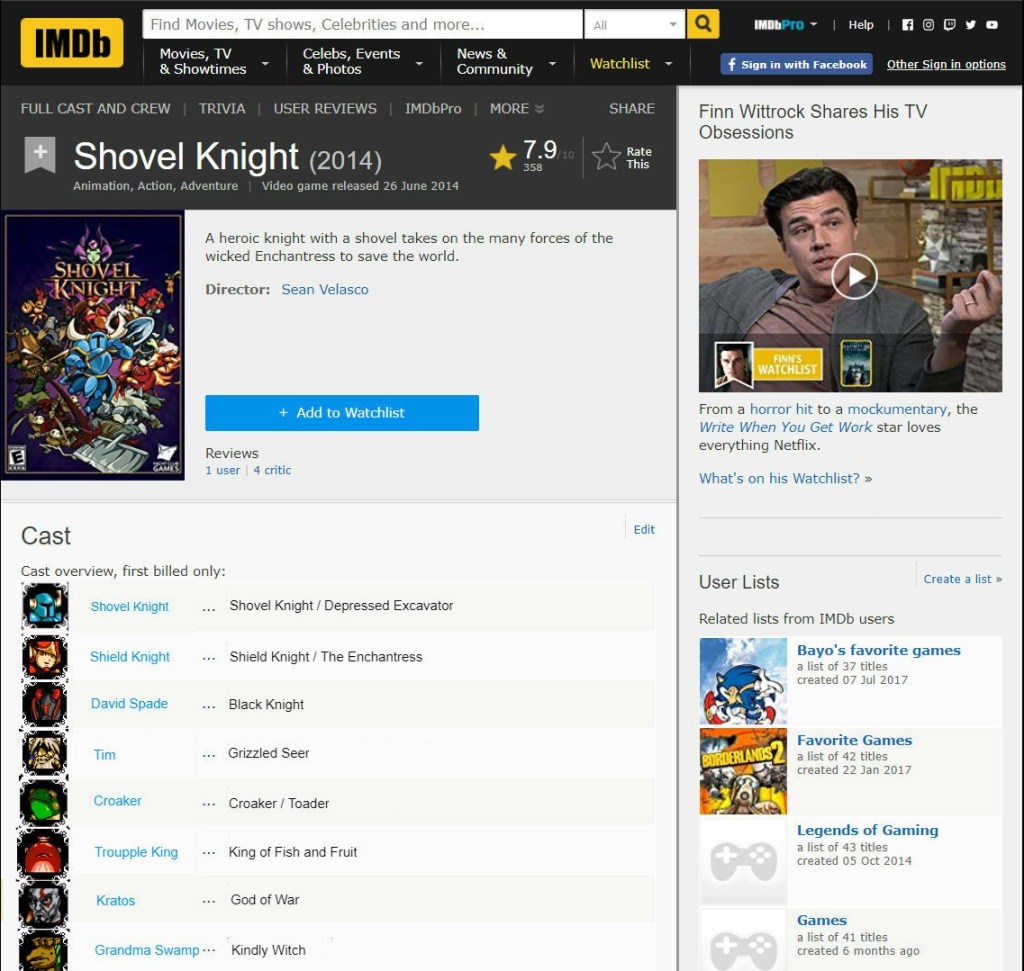
This detail extends to the main cast as well. Shield Knight isn’t a damsel trope, she’s equal to shovel knight, a capable adventurer in her own right, and provides the main plot twist. Her supposed death leaves Shovel Knight in depression, blaming himself and giving up adventuring to cope with the grief. He fights the Order to find out what happened to Shield Knight, not to stop their takeover. His motivations are understandably selfish, and given his emotional state, there are implications this could be his last quest. Likewise, Shovel Knight’s rival, Black Knight, is more than just an edgy pallet swap, he’s easily the most complicated member of the main cast. He refuses to align himself with the Order, protecting the Enchantress by his own accord and is the first to recognize her as a possessed Shield Knight. After being unable to free her, David Spade stood guard until he could find a solution. Joe Dirt was hostile towards Shovel Knight to protect her, and blames him for Shield Knight’s transformation. The Beautiful Loser even becomes an ally in the final fight, rescuing Shovel Knight at Shield Knight’s behest, burying the hatchet between them and firmly securing himself in the friend zone. In a genre where the main character is often a blank slate, this game’s got character in spades.
Yacht Club could have stopped there and written an above average romance novel, but they decided to use their gameplay to help tell the story. The most striking example of this surfaces in Shovel Knight’s dream sequences, a thematic element repeated throughout the game. During these segments, Shovel Knight tries to catch an earthbound Shield Knight before she hits the ground; all while fighting off an increasing number of enemies from previous stages. Every dream ends with Shield Knight just out of Shovel Knight’s grasp, and by the time she needs to be caught for real, you’re emotionally invested in breaking her fall. This element of gameplay gets players to connect with Shovel Knight, sharing in his stress at the increasing difficulty of his nightmares, and experiencing the relief of finally catching Shield Knight. You’re not just empathizing with him; the gameplay directly impacts how you feel. Unfortunately, there’s no nightmare where Shovel Knight tries to punch Black Knight, and his arm turns into a wet noodle on contact, but the emotional investment these sections accomplish provides a marriage of gameplay and story that many games don’t achieve.
While Shovel of Hope is a linear story, it uses its abilities as a game to give player’s control over the narrative in two major ways. First, if playing as a depressed excavator isn’t enough to entice you, the game provides the player with the option to select genders for the main cast. That way Shovel Knight can become a progressive female heroine or upturn industry standards by transitioning into the blade of his namesake. Second, after completing the last supper of boss rushes, the player is presented with the choice of saving the Order, dangling precariously over the tower’s edge, or to shove off and finish the level. Rescuing the Order rewards the player a final exchange with the supporting cast before facing the final boss. While leaving your opponent’s hanging is out of character for Shovel Knight and lacks any repercussions, this is the only plot-related choice in the game. As shallow as it is, this decision makes the player an active participant in shaping the story, a narrative tool unique to the interactive medium of video games.
I’m not going to call a spade a shovel and say Shovel Knight is a literary masterpiece. It’s a fantastic game, with a fun aesthetic, and while Shovel Knight doesn’t upturn video game storytelling, it certainly widens the gap between its competitors. The narrative doesn’t hinder gameplay, yet it features surprisingly nuanced dialogue, sympathetic characters, and requires active participation from its players. For a genre of games that don’t rely on storytelling, often forgoing it altogether, Yacht Club has an obvious passion for all aspects of its game. With Shovel Knight’s strong foundation, I am excited to see how their storytelling translates to the rest of their work as Shovel of Hope was one worth retreading and offered an experience, that I really dug.
What did you think of Shovel Knight?
Let me know in the comments below!
 Channel Cousin